

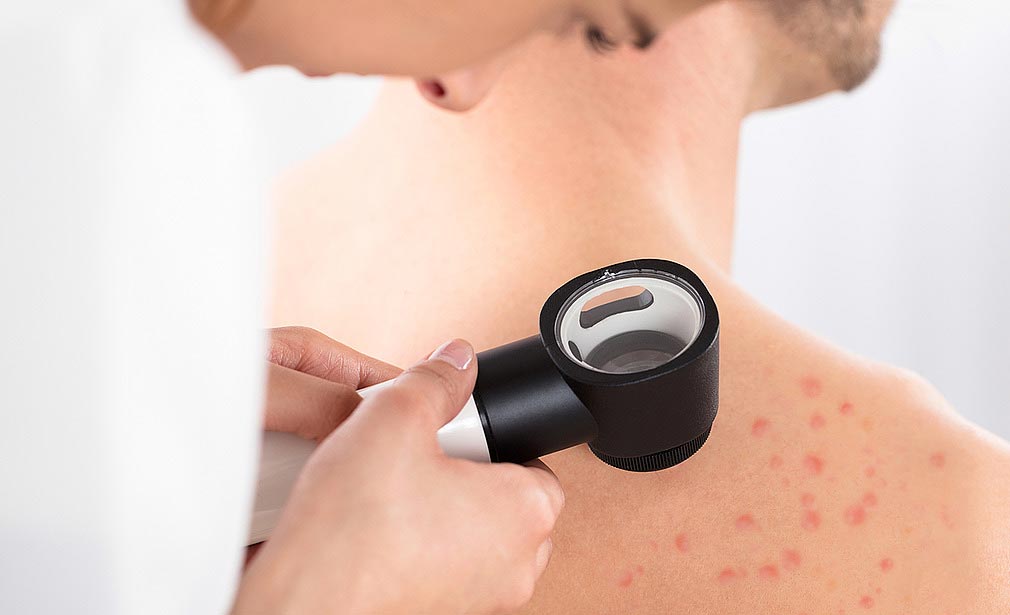
The skin is our body’s largest organ. It has a very complex structure. This complex structure contains various cells and tissues. What we call a tumor is masses originating from these cells or tissues. In other words, ‘tumor = mass’. Skin tumors/masses can be either benign or malignant.
Malignant Skin Tumors
The main cause of skin cancer is ultraviolet rays from the sun. Electric lamps emitting ultraviolet light and artificial tanning light sources can also cause skin cancers. It is a known fact that the thinning of the ozone layer, which protects the world against ultraviolet rays, has caused a serious increase in skin cancers.
Those at highest risk include:
- People with fair skin,
- Those who easily develop freckles on their skin,
- Those with numerous moles (nevi) of varying shapes and sizes,
- Those with a family history of skin cancer,
- People who spend extensive time outdoors,
- Those living in regions near the equator, at high altitudes, or exposed to intense sunlight year-round,
- Those who have undergone radiation therapy for any reason,
- Long-standing unhealed wounds,
- Chronic exposure to chemical carcinogens such as tar, pitch, arsenic, etc.,
- Skin cancers can also develop due to exposure to chronic micro-traumas.
Malignant skin tumors can be examined under 3 categories: Basal Cell Cancer (BCC) originating from basal cells in the epidermis, Squamous Cell Cancer (SCC) originating from squamous cells, and Malignant Melanoma (MM) originating from melanocytes (melanin-producing cells).
- BCC is the most common skin cancer. It progresses slowly, doesn’t spread throughout the body, and rarely threatens life. It causes local destruction.
- SCC is another common type of skin cancer. It’s frequently found on lips, face, and ears. It can spread to lymph nodes and sometimes internal organs. If untreated, SCC can become life-threatening.
- MM is less common. Its frequency is increasing especially among people living in sunny regions. It’s the most dangerous type of skin cancer. However, if detected early, there’s a chance for complete treatment. Delay in diagnosis and treatment is usually fatal.
Basal and Squamous Cell Cancers can appear in various forms. Generally:
- As a small white and pink mass,
- With a smooth, shiny, or concave surface,
- As a dry, scaly, red spot,
- As a crusted, red, nodular mass,
- As adjacent small masses with crusts,
- With visible capillaries,
- As a white patch resembling a scar.
- Lesions that don’t heal within 2-4 weeks and may cause bleeding and pain should be considered potentially cancerous.
Malignant Melanoma typically starts from a mole or normal skin. The following changes in any mole should be considered warning signs for cancer:
- Asymmetry
- Border irregularity
- Color variation
- Crusting
- Bleeding
- Itching
- Surrounding redness
- Increased hair growth
- Size increase of more than >6 mm or abnormal growth.
Moles showing one or more of these changes should be surgically removed and subjected to histopathological examination for Malignant Melanoma. If all these variables seem complicated to you, it’s important to remember this: Know your skin and examine it regularly from head to toe. If you notice anything suspicious, immediately consult a Plastic Reconstructive and Aesthetic Surgery specialist! Plastic Surgeons surgically remove tumors while preserving functional structure and ensuring the most aesthetic appearance. Histopathological examination of the removed tissue can determine whether it was completely removed and if any residual tissue remains.
How is it Treated?
Treatment varies depending on the type of cancer, growth stage, and location. If the cancer is small, the procedure can be easily performed as an outpatient under local anesthesia. For these small and less dangerous types, curettage or desiccation (destroying cancer cells with electric current) procedures can also be performed. However, these methods are less reliable for treatment and have higher chances of scarring and deformation. If the cancer is large or has spread to lymph nodes or other parts of the body, major surgical procedures may be necessary. Other possible treatment options for skin cancers include cryotherapy (destroying cancer cells by freezing), radiotherapy (radiation treatment), and chemotherapy (administration of anti-cancer drugs).
- Before starting treatment, you should evaluate these methods with your doctor and seek answers to the following questions:
- Which treatment method is more reliable for tumor elimination?
- Which option is more suitable for you?
- How effective is it for your type of cancer?
- What are the possible risks and side effects?
- How achievable are your expected functional and cosmetic results?
- The ideal treatment method determined by these answers should be implemented without delay. Complete treatment becomes more difficult in delayed cases.
Benign Skin Tumors
Nevi (Moles), seborrheic keratosis, epidermoid cyst, dermatofibroma, lipoma, dermoid cyst, lentigo, pyogenic granuloma, wart, milia, pilar cyst, syringoma, etc. The number of benign skin tumors can be expressed in hundreds. Therefore, I want to discuss the general approach rather than what these tumors are. If a lesion shows no growth, no color change, no bleeding-crusting-itching, and has regular borders, it’s likely benign. Whether a tumor is benign or malignant can be definitively determined through pathological examination, but an experienced doctor can largely make this distinction without pathology. It should be remembered that Plastic Reconstructive and Aesthetic Surgery or Dermatology are the most effective specialties in determining whether a skin mass is benign or malignant. Therefore, I recommend showing a mass you think is benign to a specialist and considering their advice.
In benign skin tumors, if there is growth, bleeding, persistent itching, or shape irregularity, surgical removal and pathological examination are absolutely necessary. Benign skin tumors don’t require surgical removal outside of these changes. However, they can be removed at the patient’s request if they cause visual-aesthetic discomfort. There is no harm in removing them. The common belief that removal causes multiplication or growth is completely unscientific and incorrect. When a benign skin tumor is surgically removed, the only outcome is getting rid of that tumor, nothing else.

