

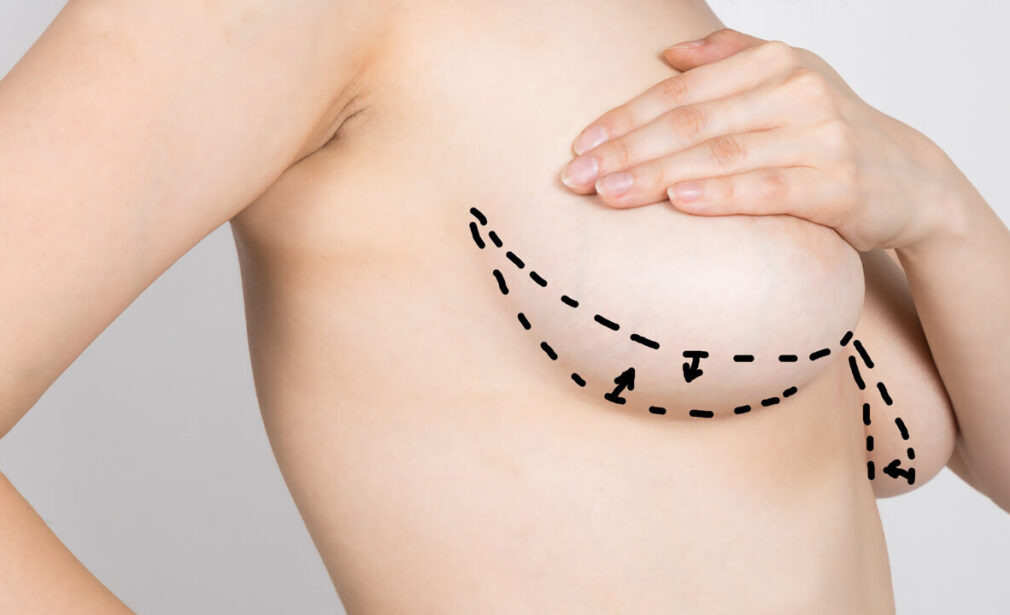
Breast reduction surgery is an aesthetic operation performed on large and sagging breasts that have lost their aesthetic structure and negatively affect health, such as putting extra weight on the spine. Planning is done according to the individual before breast reduction surgery. In the planning, it is ensured that the person’s breast size reaches a certain size after the surgery. During the surgery, excess tissues in the breast are removed to achieve reduction.
How is Breast Reduction Surgery Performed?
- Serious planning is done before the surgery. This planning is the most important phase of the operation.
- The nipple is moved from its current position to its new, ideal location higher on the body.
- Excess skin, breast tissue, and fat are removed from the breast. These excesses are mostly in the sagging part at the bottom of the breast. After removing the excess, the remaining tissues are gathered in the middle to give the breast an upright and beautiful appearance.
- The surgery is performed under general anesthesia and takes an average of 3-4 hours.
- After the surgery, a drain is placed in each breast to prevent blood accumulation, serving as insurance.
- When leaving the surgery, a special bra is put on to shape the breasts. You will be hosted in the hospital for one day, and your drains will be removed when you are discharged.
- You can take a bath on the 3rd day after the surgery, and your dressing will be renewed on the same day. The stitches do not need to be removed as they are self-dissolving and hidden.
- You need to use the bra for 3-6 weeks.

What are the Risks of Breast Reduction Surgery?
Breast reduction surgery is not a surgery that carries more risks compared to other aesthetic surgeries, although it takes longer. Complications such as wound infection, bleeding, suture separation, and tissue death, which can be seen in any surgical intervention, are very rarely observed after the surgery.
Specific to breast surgery, nipple sensory disorders and inability to breastfeed during pregnancy may occur. After the surgery, nipple sensation may decrease or increase. This condition is largely temporary and returns to normal within 6-12 months. With appropriate techniques, 90-95% of patients can breastfeed. Due to the nature of the surgery, there is no technique that can be performed to guarantee 100% preservation of breastfeeding ability.
So, what is the process after breast reduction surgery? When leaving the surgery, a special bra is put on to shape the breasts. You will be hosted in the hospital for one day, and your drains will be removed when you are discharged. You can take a bath on the 3rd day after the surgery, and your dressing will be renewed on the same day. The stitches do not need to be removed as they are self-dissolving and hidden. You need to use the bra for 3-6 weeks. After a week, you can easily return to your daily life and to your job if it’s not strenuous. After the second week, you can do light sports, and after the sixth week, you can do heavy sports. When you look at breast reduction surgery reviews, you can see that people who have had the surgery are extremely satisfied.
Breast reduction surgery is performed to reduce large, sagging breasts and achieve an appearance proportional to the body structure. Today, millions of women worldwide are seeking ways to reduce their breasts due to discomfort with their breast size. We offer a solution to this issue with breast reduction surgery.
Large breasts create serious problems for women. Breasts that are larger and heavier than normal distort a woman’s physical appearance. They cause deformation and herniation in the neck and back vertebrae, leading to pain. Over time, normal posture is disrupted, resulting in hunching. Frequent chafing and fungal infections occur due to excessive sweating on the lower surface of the breasts that contacts the abdominal skin. Bra straps leave deep marks on the shoulders and cause shoulder depressions. They cause limited movement. Combined with efforts to conceal breast size, difficulties in clothing selection, inability to wear desired clothes, and other social problems, psychological issues up to depression can be observed.
The lower limit is 18, and there is no upper limit. The lower limit of 18 is not a definite age, but it’s mostly my personal approach that I pay attention to. The reason is to wait for breast development to reach a certain point and for the person to be psychologically ready for the operation. Otherwise, it can be performed with parental consent for individuals under 18 who experience psychological and social difficulties due to breast size. There is no upper age limit. It can even be performed on a woman over 80 who has an active life.
We ask patients who smoke to reduce or quit smoking 1-3 weeks before the surgery. Patients with chronic diseases such as diabetes, hypertension, heart conditions, asthma, or those using medication need to have their treatments regulated and their conditions stabilized. Patients using blood thinners need to have their treatments adjusted before surgery.
In breast reduction surgery, skin, breast gland tissue, and fat tissue are removed from the breasts. However, after surgery, breast enlargement can be observed during excessive weight gain and pregnancy periods. In excessive weight gain, the increase in fat volume is prominent, while in pregnancy, the increase in breast gland volume is more noticeable, and these are in small amounts. They never return to their pre-surgery state.
First, I’d like to provide a brief explanation. The numerical values like 85-90-95 on bras indicate the chest circumference measurement around your breast area. Letters like A-B-C-D indicate your breast size, or cup size. A cup represents small breasts, while D cup represents large breasts.
Breast augmentation
, breast reduction,
breast lift
, and similar surgeries don’t change the numerical value because we don’t intervene with the chest wall. The targeted measurements after breast reduction surgery vary for each patient. The important thing is for the breasts to have a size that looks harmonious and natural considering the patient’s body structure. In our society, this measurement is mostly B or B+. For example, if you were 90D before surgery, I can say that you will be 90B or B+ after breast reduction surgery.

