
The abdomen is an aesthetically important body area that directly reflects on one’s external appearance. Tummy tuck surgery (abdominoplasty) is a procedure that yields successful results in both men and women. However, the majority of patients are women who have given birth. In aesthetic surgery, this is the procedure after which you will feel the greatest need to renew the clothes in your wardrobe.
Normally, the resistance and aesthetic flat posture of the abdominal wall is provided by a pair of muscles that extend side by side and lengthwise on the anterior abdominal wall. We call these muscles the rectus abdominis muscles. The primary function of the rectus muscle is to pull the body forward. In women, the rectus muscles undergo the most deformation during pregnancy throughout their lifetime, while in men this occurs during excessive weight gain. In the final months of pregnancy, they cannot withstand the tension created by excessive abdominal enlargement and separate from each other, becoming deformed (rectus diastasis). Especially after repeated pregnancies, the anterior abdominal wall has lost all its resistance and its anatomical structure has been disrupted. Even in women who have reached their ideal weight after childbirth, unavoidable abdominal sagging, post-meal digestive problems, and bloating occur due to this issue. The insufficient resistance of the abdominal wall allows the stomach to expand comfortably and plays a facilitating role in continuous weight gain.
In women or men, the only change after abdominal enlargement is not in the rectus muscles. In addition to muscle deformation, the abdominal skin is also affected by this change. Deep cracks called striae form in the abdominal skin, the skin sags and loses its quality. These changes in the abdominal wall and skin do not return to their original state through sports, exercise, diet, skin care, etc., and do not benefit from procedures other than surgery.
How Is Tummy Tuck Surgery Performed?
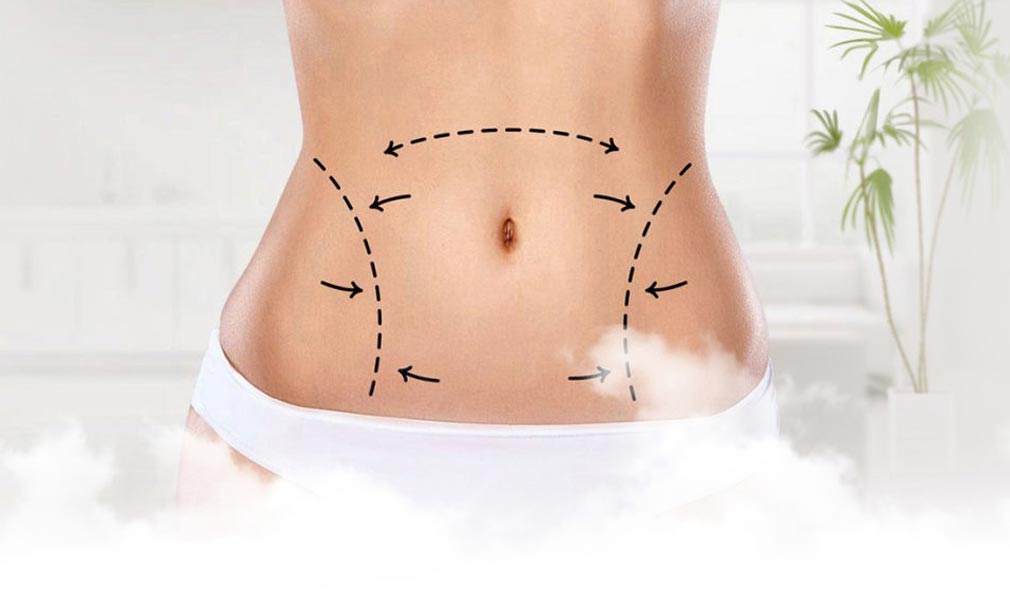
Tummy tuck surgery is a 3-stage procedure.
- First, the fatty tissues in the anterior and lateral parts of the abdomen are removed using the liposuction method, achieving a slim appearance in both the abdomen and waist.
- Second, the skin and subcutaneous tissue in the sagging abdominal area containing dense stretch marks below the navel is removed. The abdominal skin is tightened and the navel is sutured to its new position.
- Third, the deformed muscles in the anterior abdominal wall are brought closer together and the abdomen is made flat.
Abdominoplasty is among the procedures for which I paint the most optimistic picture for my patients in the post-operative process. Because I can tell my patients that they will lose 2-4 dress sizes immediately after surgery, and if they follow my recommendations in the following 2-3 months, they will lose at least 2 more dress sizes. During surgery, a 2-4 dress size reduction is immediately achieved through both the liposuction procedure performed and the plication procedure applied to the rectus muscles. In the following process, if patients maintain a diet that is low in carbohydrates and high in fluids, losing that much more weight is not a dream. There are several factors that enable this, of course. First, following a specific diet program after tummy tuck surgery is much easier because the physical change due to surgery highly motivates the patient. The plication performed on the abdominal wall compresses the stomach from the front, the stomach cannot expand as comfortably as before, and therefore the feeling of satiety occurs much more quickly. Finally, the patient who previously had difficulty moving due to excess weight can move much more easily, moving away from a sedentary lifestyle and increasing calorie consumption.
Tummy tuck surgery is a procedure performed under general anesthesia lasting approximately 2 hours. The patient leaves the operating room wearing a special corset. The patient is asked to wear this corset for 4-6 weeks. In rare cases where there is a risk of bleeding, drains are placed for safety purposes and removed after 2 days. The patient begins walking 4 hours after surgery. The patient stays in the hospital for 1 day. When the patient is discharged from the hospital, they are walking on their own and able to meet their toilet and hygiene needs. Remember that you will feel the need to largely change the clothes in your wardrobe after surgery.
Pregnancy after Tummy Tuck Surgery
There is no problem with becoming pregnant after tummy tuck surgery. However, if you plan to become pregnant within 12 months, I recommend postponing this surgery until after pregnancy. After all, every pregnancy period creates changes in the female body. The beautiful appearance and gains you achieve after surgery will be somewhat lost with pregnancy. Therefore, I recommend postponing the surgery to patients planning pregnancy, to meet again 6-12 months after delivery.
What are the Risks of Tummy Tuck Surgery?
As with every surgical intervention, there are certain risks in tummy tuck surgery as well. These risks are minimized with precautions taken.
The most common complications in tummy tuck surgery are infection, bleeding, blood clots, fluid accumulation, and poor healing of the surgical scar.
Antibiotics are recommended to the patient against possible infection risk. If there is infection or abscess formation, immediate action is taken.
Compression stockings are recommended to the patient against blood clot formation. Additionally, regular walking prevents the possibility of blood clots.
If the patient is not diabetic and does not smoke, it is not very likely for surgical scars to turn into poor wounds. However, if this occurs, scar treatment can be applied to the patient.
How many Dress Sizes Does Tummy Tuck Surgery Reduce?
Tummy tuck surgery is among the procedures for which we paint the most optimistic picture. After surgery, a reduction of 2 to 4 dress sizes is possible. If the program is followed, an additional 2 dress size reduction can be achieved within 2-3 months.

